Karst regions in southwestern China are among the most fragile agricultural landscapes worldwide. Rocky desertification threatens both ecosystems and local farm livelihoods. Multifunctional agroforestry systems (AFSs) have been promoted as a way to restore degraded soils while sustaining crop production. However, few studies have focused on their functional performance in karst environments.
In a study published in Agroforestry Systems, researchers from Xishuangbanna Tropical Botanical Garden (XTBG) of the Chinese Academy of Sciences and their collaborators found that intercropping fruit trees with medicinal plants can fundamentally reshape the multi-element nutrient network across soil, roots, and leaves in fragile karst landscapes. The findings suggest that well-designed agroforestry can improve nutrient coordination and resilience in one of the world’s most fragile agricultural landscapes.
The researchers examined how multifunctional AFSs regulate multi-element stoichiometric relationships in soil-plant systems in the karst region of Southwest China, and what these effects imply for sustainable management. They compared a Prunus salicina monoculture (Pm) with several AFSs. The understory species included Hypericum monogynum, Polygala fallax, Rubus suavissimus, and Semiliquidambar cathayensis + Illicium difengpi. They measured the concentrations and stoichiometric relationships of macroelements and metallic elements in soil, roots, and leaves. They then assessed nutrient acquisition efficiency, root-to-leaf translocation capacity, and elemental coupling.
They found that, compared with monoculture cultivation of plum trees (Prunus salicina), AFSs incorporating different medicinal plants significantly restructured nutrient element composition and stoichiometric balances. The Prunus salicina + Rubus suavissimus system showed the largest increases in nutrient bioaccumulation factors and translocation factors. Notably, plant nutrient acquisition efficiency was more strongly linked to soil elemental ratios,especially phosphorus-based ratios,than to the absolute concentration of any single element.
Species selection also mattered more than species richness alone. Network analysis further identified calcium and manganese as key integrators linking nutrient dynamics across soil, root, and leaf compartments, suggesting that these elements act as hubs in the plant–soil nutrient network.
The findings indicate that nutrient management in karst orchards needs to shift from traditional single-element supplementation of nitrogen and phosphorus to coordinated regulation of multiple elements. In particular, calcium–magnesium balance and iron- and manganese-related ratios should be optimized.
“When selecting understory medicinal plants, managers should prioritize functional matching rather than simply pursuing species abundance,” said LIU Chenggang of XTBG.
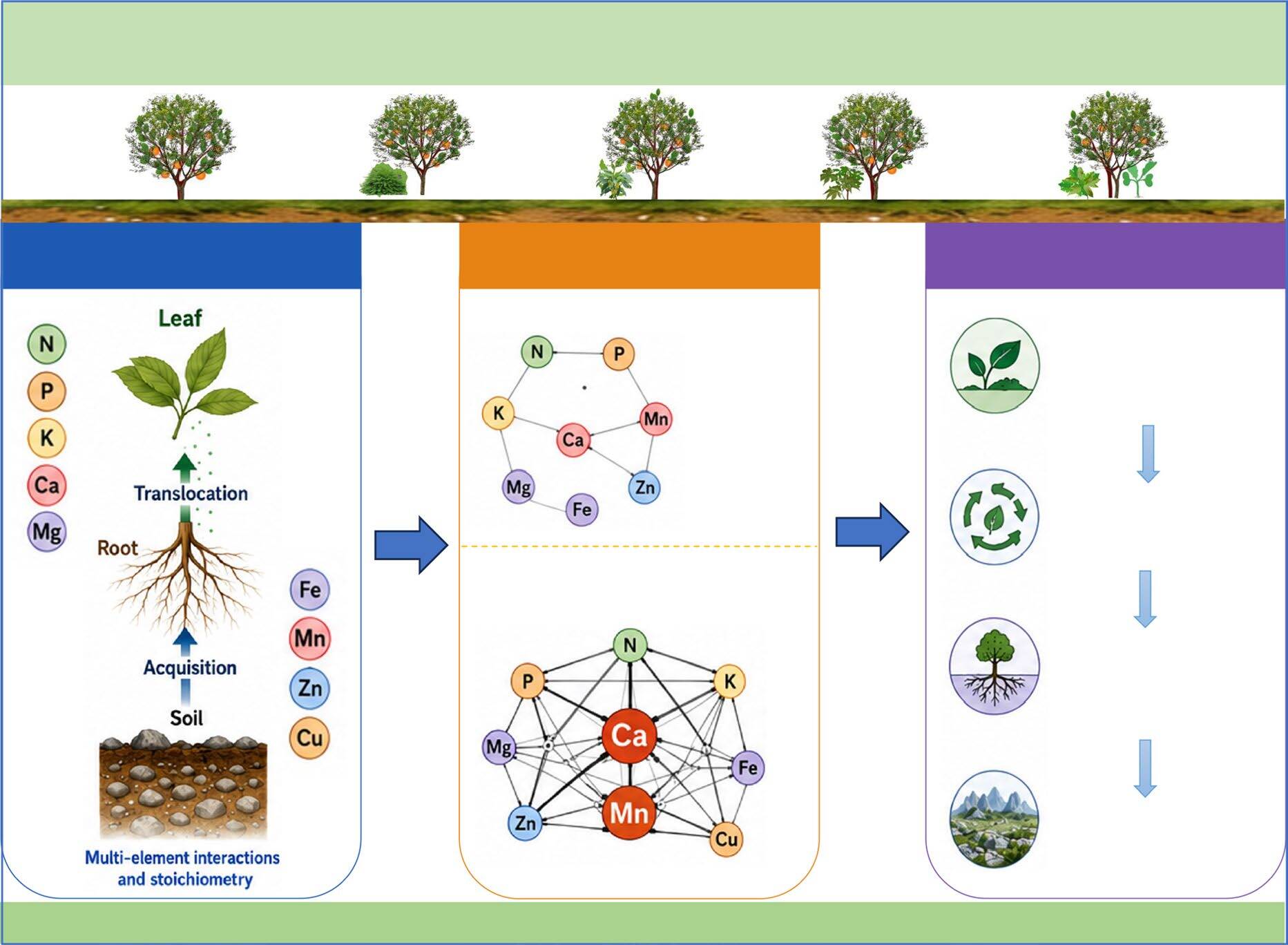
Agroforestry reshapes multi-element stoichiometry and nutrient-network integration
across the soil–plant continuum in karst region. (Image by CHEN Shujie)
Published: 22 August 2026


