Urbanization acts as a powerful ecological filter, fundamentally reshaping species interactions. As tropical cities continue to expand rapidly, understanding how this process alters species interactions has become increasingly urgent.
In a study published in Urban Forestry & Urban Greening, researchers from Xishuangbanna Tropical Botanical Garden (XTBG) of the Chinese Academy of Sciences investigated the impact of urbanization on the ecological relationships between strangler figs and their host trees, and they propose corresponding recommendations for urban forestry management.
Surveying more than 50,000 trees, the researchers compared strangler fig communities in the urban area of Jinghong with those in a nearby protected tropical rainforest in Xishuangbanna. They quantified changes in species diversity, abundance, and the structure of ecological networks linking figs to their hosts.
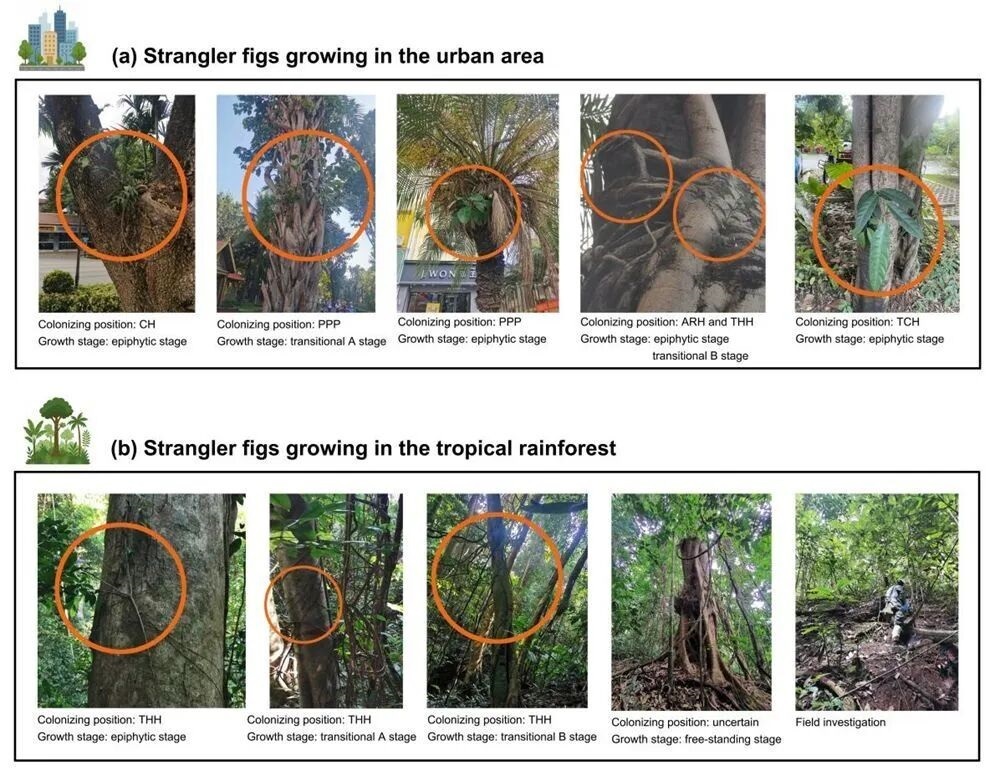
In the urban area of Jinghong, the researchers recorded 1,205 strangler fig individuals, more than six times the 191 found in the rainforest. Despite this numerical abundance, urban figs rarely reached the stage where they pose a threat to their hosts: 48% remained in the epiphytic stage, 40% were in early transitional stages, and only 0.2% had become free�standing after killing their host tree. In contrast, within the rainforest, 63% of figs had advanced to later transitional stages and 6% were free�standing.
This disparity likely arises from a combination of factors: routine pruning, the relatively young age of urban trees, and the harsh urban microclimate, which impedes aerial roots from successfully reaching the ground.
In the rainforest, strangler figs and their hosts formed a highly specialized, modular network. In the city, however, this complex architecture gave way to a more generalized and nested structure, dominated by a few generalist fig species capable of colonizing a wide variety of hosts. Notably, the introduced oil palm (Elaeis guineensis) emerged as a particularly important host, frequently supporting multiple strangler fig species.
"Our data suggest that a dual management approach is needed," said SONG Liang of XTBG. "In areas where biodiversity conservation and cultural heritage are priorities, strangler figs can be retained as ecological assets. But where public safety or the health of high�value host trees is a concern, targeted monitoring and early intervention on susceptible species, especially palms,offer a practical risk mitigation strategy."
The study also identified specific traits that influence fig establishment. Host tree height proved to be a significant factor, with taller trees more likely to be colonized. The position of colonization on the host tree also mattered: lower attachment points were associated with greater progression to later developmental stages.
Available online: 18 June 2026


