In a study published in Bulletin of Chinese Academy of Sciences, researchers from Xishuangbanna Tropical Botanical Garden (XTBG) call for urgent scientific cooperation to document, protect and sustainably use Laos’ rich but understudied flora.
Laos is the first country to sign a bilateral community-with-a-shared-future action plan with China. It is home to an estimated 8,000–11,000 flowering plant species. Situated in the Indo-Burma biodiversity hotspot, the country serves as a crucial ecological bridge between continental Asia and the Malay Archipelago.
However, XTBG researchers note that Laos’ plant diversity remains severely understudied: no complete national plant checklist exists, field surveys are patchy, and local taxonomic expertise is extremely limited.
“Biodiversity loss is one of the three major global environmental crises,” said XTBG researchers. “But without systematic knowledge of what species exist and where, effective conservation is impossible.”
The researchers reviewed two centuries of botanical exploration in Laos, which beginning with French colonial-era work. Although recent decades have seen renewed activity, including more than 280 new species published between 1980 and 2020, major gaps persist. Large areas such as the Bolaven Plateau, karst forests in Khammouane Province, and high-altitude cloud forests remain poorly explored. Ferns, mosses and other cryptogams have received little attention.
Under the Belt and Road Initiative (BRI), Chinese scientists have already organized multiple joint expeditions, trained Laotian graduate students, and discovered new species.
A landmark project now underway is the planned compilation of the Flora of Laos, which aims to document over 90% of the country’s vascular plants within approximately 15 years.
“The Flora of Laos will be a milestone. It will correct taxonomic errors in colonial-era literature, provide a scientific basis for red-list assessments, and support protected area planning and sustainable resource use,” said XING Yaowu of XTBG.
Through continued collaboration and joint efforts between Chinese and Laotian scientists, plant diversity in Laos is expected to become a model for regional biodiversity cooperation in Southeast Asia under the Belt and Road Initiative.
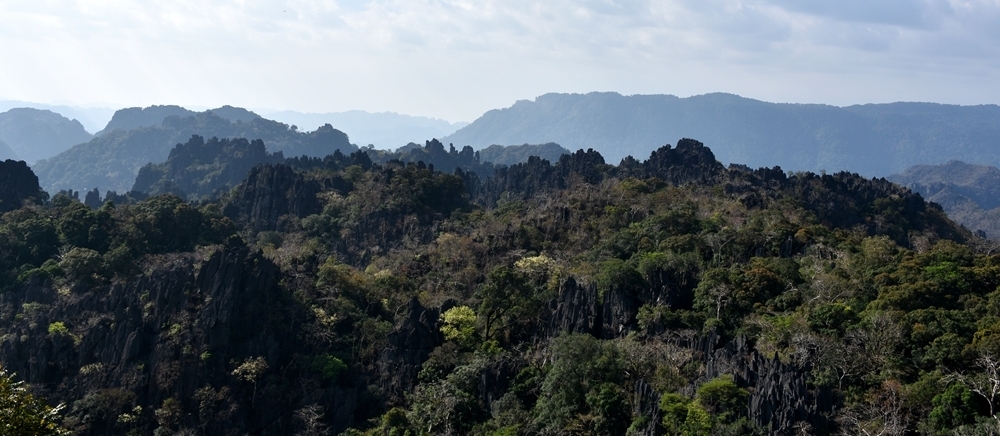
Vegetation of Laos. (Image by MENG Honghu)


