In a study published in New Phytologist, researchers from Xishuangbanna Tropical Botanical Garden (XTBG) of the Chinese Academy of Sciences and Northeast Forestry University reveal that trees adopt distinct strategies to balance water transport, sugar distribution, and storage depending on their climate.The study is the first to systematically compare functional ratios in mature canopy woody plants.
The researchers used canopy cranes to collect standardized samples in four typical Chinese forests (tropical, subtropical, temperate) in Xishuangbanna, Ailao Mountain, Lijiang, and Changbai Mountain, covering both latitudinal and altitudinal gradients. They analyzed the allocation patterns of functional ratios (e.g., xylem, phloem, and ray parenchyma to leaf area ratios) in 55 canopy woody tree species under different climatic conditions and their environmental driving factors
Their results show that trees in cold, high-altitude, and high-latitude regions invest more in xylem and phloem per unit leaf area than trees in warm, humid tropical forests. This suggests that in cold climates, trees prioritize storage capacity and the ability to repair damage from freeze-thaw cycles over high-capacity transport systems.
The ratio of ray parenchyma to leaf area also increased significantly at higher altitudes, reflecting a greater need for storage under light limitation and freeze-thaw stress. Notably, while functional ratios varied considerably across different climate zones, plants with different growth forms showed convergent strategies within the same forest environment. This convergence indicates that environmental filtering is the dominant force shaping branch-level allocation strategies.
The researchers also found that the xylem-to-phloem functional ratio is closely linked to plant height, wood density, and hydraulic conductivity, showing that these allocation strategies are tightly connected to overall physiological function.
“Our findings demonstrate that functional ratios diverge across climates but converge within similar environments, suggesting environmental filtering drives storage-transport balances,”said CHEN Yajun of XTBG.
By clarifying how canopy trees balance survival and growth resources across climate zones, the findings offer valuable scientific guidance for forest management and conservation in the context of global climate change.
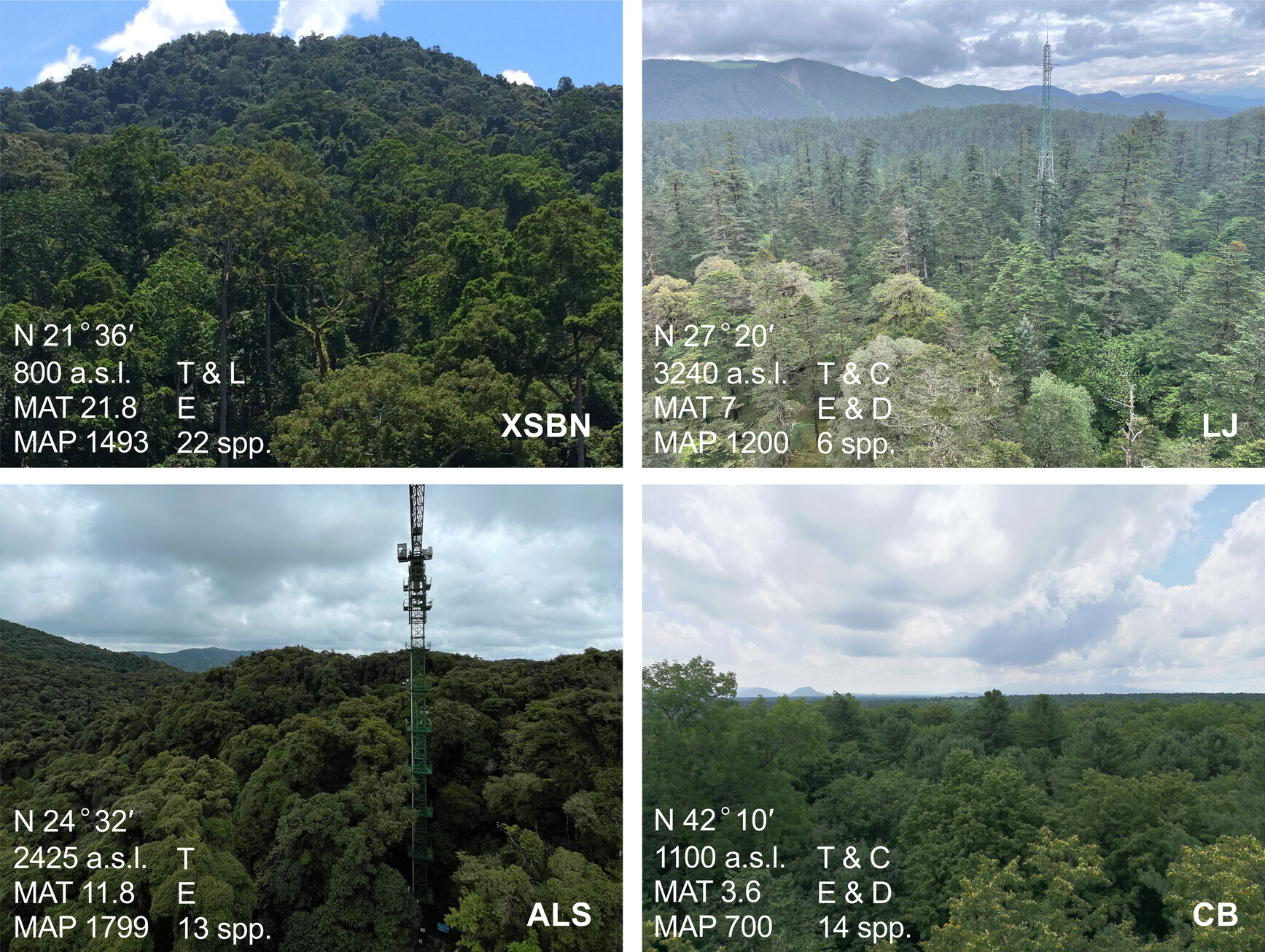
Canopy view of the four typical Chinese forests. (Image by XTBG)
First published: 10 March 2026


