Phosphorus is essential for plant growth and ecosystem productivity. In many natural forests, plants rely on soil microbes to release bioavailable phosphorus from organic matter. The PhoD gene, which codes for the enzyme alkaline phosphatase, is a central marker for this microbial process. Although its role in fertilized agricultural systems is well-known, its distribution and drivers in natural forest ecosystems have remained unclear.
In a study published in Functional Ecology, researchers from Xishuangbanna Tropical Botanical Garden (XTBG) of the Chinese Academy of Sciences investigated the spatial distribution characteristics of the PhoD gene and its environmental driving factors in tropical and subtropical forests. They revealed that the abundance of PhoD, a critical microbial gene responsible for phosphorus mineralization in forests, was primarily shaped by elevation, soil pH, and calcium availability.
The researchers investigated the spatial distribution of the PhoD gene abundance across three 20-hectare forest plots in Yunnan, China: the lowland tropical forest of Bubeng, the mid-elevation tropical forest of Nabanhe, and the high-elevation subtropical evergreen broad-leaf forest of Ailaoshan. Using molecular techniques, they quantified PhoD gene abundance and examined its relationship with geographical, soil chemical, and biotic factors.
Striking differences in PhoD gene abundance were observed among the forests. Abundance was highest and most widespread in the mid-elevation Nabanhe forest, intermediate in the lowland Bubeng forest, and lowest in the high-elevation Ailaoshan forest.
At the regional scale (across all three forests), elevation, soil pH, and calcium availability were identified as the top three predictors of PhoD gene abundance. Soil pH consistently emerged as a primary driver at both regional and local scales. The effect of elevation was mediated through changes in soil pH and macronutrient levels (total carbon, nitrogen, and phosphorus). Within individual forests, spatial patterns were linked to variations in soil parent material, which influenced local soil pH and calcium content.
"Our findings demonstrate how elevation-driven environmental changes shape the genetic potential for phosphorus mineralization in soil. Soil pH acts as a consistent filter, constraining the microbial community capable of performing this vital function across different landscapes," said YANG Xiaodong of XTBG.
The study lays an important foundation for predicting how the PhoD gene may respond to climate change.
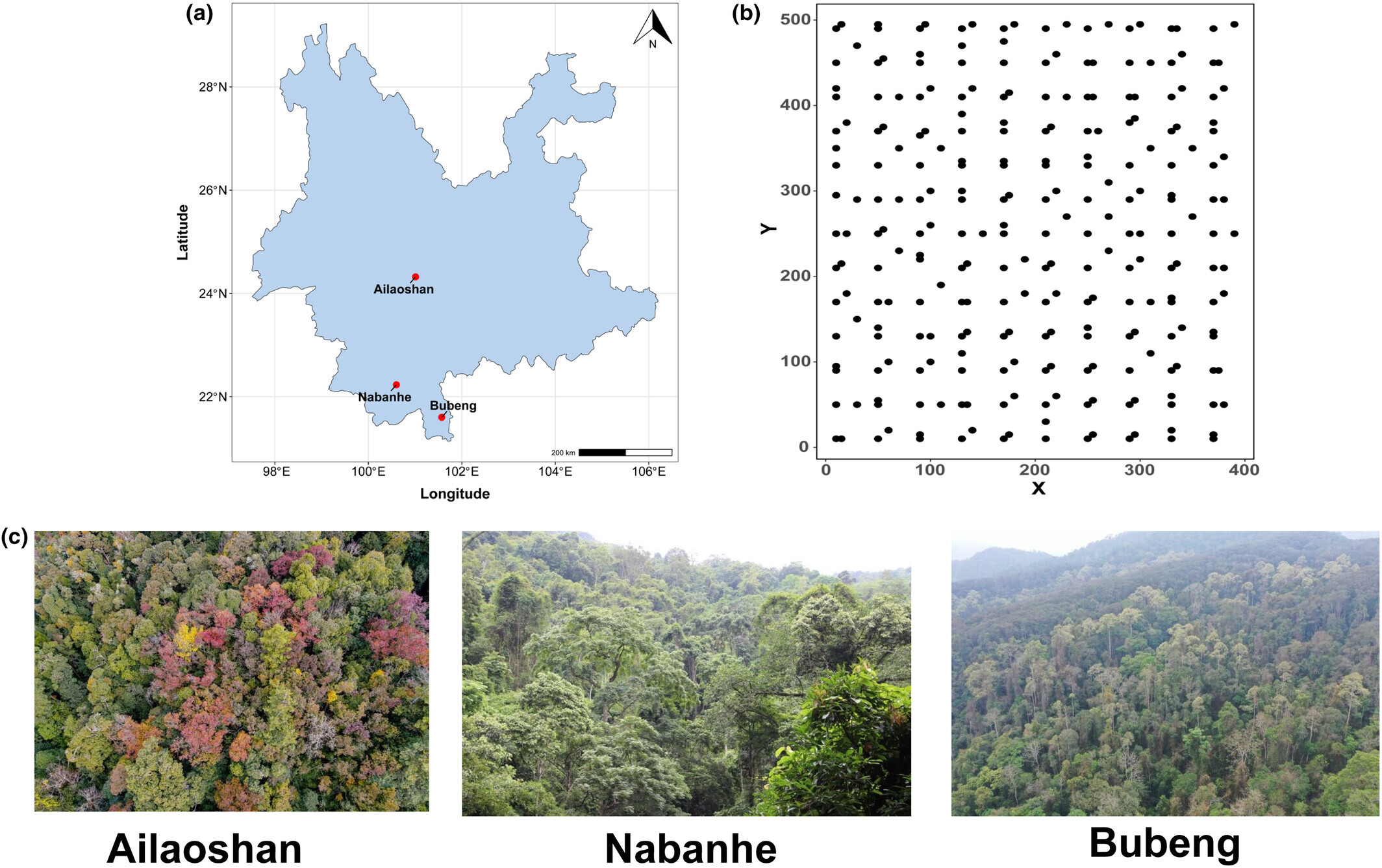
Study area and sampling design. (Image by Sandhya Mishra)
First published: 03 February 2026


