Iron (Fe) is a vital micronutrient for plants, required for key processes such as photosynthesis and enzyme activity. To maintain health and productivity, plants must carefully manage iron levels, activating iron uptake genes when deficient and suppressing them when iron is excessive to prevent toxicity. This careful balance is known as iron homeostasis.
Previous research has identified two main strategies plants use to acquire iron: a reduction-based method (Strategy I) and a chelation-based method (Strategy II). While root responses to iron shortage have been widely studied, much less is known about how shoots, which make up most of a plant’s biomass and require more iron, regulate their iron status.
In a study published in The Plant Cell, researchers from the Xishuangbanna Tropical Botanical Garden (XTBG) of the Chinese Academy of Sciences have uncovered how a network of proteins works together to regulate iron balance throughout the whole plant. The finding fills an important gap in understanding how plants manage this essential nutrient.
The researchers investigated the role of iron sensors BRUTUS (BTS) and its related proteins BTS-LIKE1/2 (BTSL1/2), along with a group of transcription factors called bHLH IVc (including bHLH34, bHLH104, bHLH105, and bHLH115) in regulating iron homeostasis.
Using Arabidopsis thaliana as a model, the researchers identified central regulatory proteins that direct distinct iron-deficiency responses in roots and shoots.
BTS was found to safeguard plant health by preventing iron overaccumulation in shoots and mitigating iron toxicity. In contrast, BTSL1/2, predominantly active in roots, functioned to downregulate iron-deficiency responses and control iron uptake. The bHLH IVc transcription factors interacted with BTSL1/2 to mediate iron balance between roots and aerial tissues.
Experimental data showed that the bts-2 mutant displayed leaf chlorosis and sterility phenotypes under iron-sufficient conditions, along with significant upregulation of reactive oxygen species (ROS)-related genes, highlighting the critical function of BTS in preventing iron overload toxicity.
“Our study helps solve the long-standing question of how iron signaling is coordinated across the whole plant. It reveals a functional division of labor among regulatory proteins and identifies the bHLH IVc group as a central hub for systemic iron homeostasis,” said LIANG Gang of XTBG.
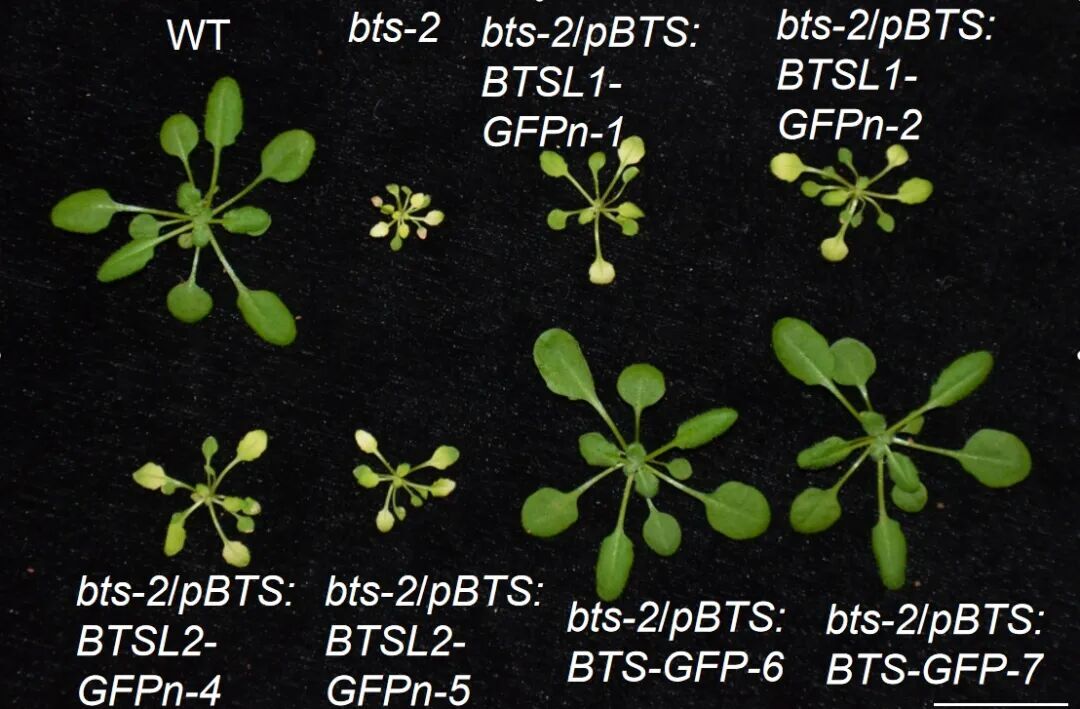
Growth of Arabidopsis thaliana under different treatments. (Image by ZHAO Junhui)
Published: 16 January 2026


