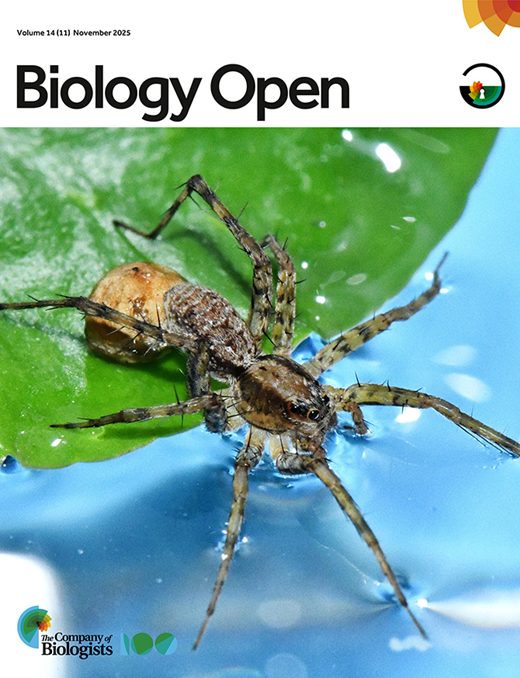
In a study published in Biology Open, researchers from Xishuangbanna Tropical Botanical Garden (XTBG)reveal the sophisticated maternal strategies of wolf spiders. The study show that the arachnids can fine-tune their egg-sac care based on their babies' development and dramatically adjust their escape speed depending on the level of environmental threat.
The researchers combined controlled brooding experiments with survival-based escape assays under ecologically relevant conditions (sun exposure, flooding, predator cues) to systematically investigate the adaptive strategies of maternal spiders and their response mechanisms to environmental risks during egg sac hatching behavior. The wolf spider Pardosa pusiola was chosen for its representative maternal behavior, where females continuously carry an attached egg sac for 2-4 weeks, then open it to release spiderlings.
While spider embryos hatch inside the sac on their own, the physical emergence of the hatchlings is entirely dependent on the mother. She must sense the right moment to split open the sac. Motherless egg sacs contained fully developed but trapped spiderlings.This timing is not rigid but is a flexible response to cues from the developing embryos. Crucially, the communication appears species-specific.
The researchers also quantified how carrying a bulky egg sac affects a mother's survival skills under different ecological risks. As expected, under moderate stress (like mild sun exposure), females carrying egg sacs escaped slower than unburdened females. However, under acute threats, such as intense heat or the simulated presence of a predator, the carrying mothers performed remarkably, escaping just as fast or even faster than those without egg sacs. This suggests mothers can actively offset the physical cost of their clutch when the stakes are highest.
“These spiders aren't just passively carrying a burden; they are actively managing a reproductive investment,”said CHEN Zhanqi . “They show a calculated trade-off, accepting a locomotor cost under low risk but mobilizing exceptional performance when the threat is severe.”
A different trade-off emerged during simulated flooding. While egg-sac-carrying females suffered higher mortality, the survivors showed no reduction in escape speed, indicating that the sac itself, not reduced ability, may increase drowning risk.
The findings illustrate how complex parental care can be maintained through dynamic behavioral adjustments. The mother’s ability to modulate both egg-sac management (based on embryonic cues) and her own locomotion (based on risk level) forms a resilient evolutionary strategy.
Contact
CHEN Zhanqi Ph.D Principal Investigator
Xishuangbanna Tropical Botanical Garden, the Chinese Academy of Sciences
mail: chenzhanqi@xtbg.ac.cn


