Spatial dynamics of preferential flow (rapid movement via macropores like root channels) and matrix flow(slower movement through soil micropores) are critical to ecohydrological processes, soil and water conservation, and groundwater pollution. However, it remains poorly understood how these two flow types interact to regulate water and solute transport in soil profiles, especially under the distinct wet and dry seasons of tropical climates.
In a study published in Soil and Tillage Research, researchers from Xishuangbanna Tropical Botanical Garden (XTBG) of the Chinese Academy of Sciences and their collaborators investigated the dynamic interactions between preferential flow and matrix flow in rubber-associated forest systems within tropical regions, as well as their impacts on soil water storage and cycling.
The researchers employed dye-tracing experiments and soil moisture monitoring across four systems of increasing root biomass and complexity: Rubber Monoculture (RM) < Rubber-Alpinia (RAO) < Rubber-Orange-Tea (ROT) < Artificial Rubber Rainforest (ARR). Through in-situ measurements, they analyzed the differences in soil water regulation mechanisms.
The results showed a substantial increase in soil water storage capacity with system complexity: gains of 18% for RAO, 23% for ROT, and 31% for ARR compared to RM. The study identified continuous rainfall, rather than short, high-intensity storms, as the primary driver activating beneficial preferential flow paths.
Furthermore, preferential and matrix flows exhibited an opposite, wave-like relationship on an annual scale. Preferential flow dominated downward movement during the rainy season, while matrix flow facilitated upward water supply from deeper layers during the dry season. This bistable, bidirectional water movement throughout the soil profile enhanced overall water transport, storage, and circulation, contributing to greater ecosystem resilience.
“The interaction between preferential and matrix flows formed a bidirectional water movement throughout the soil profiles, enhancing water transport and storage across the forest systems,” said JIANG Xiaojin of XTBG.
The study reveals the bistability hydrodynamic characteristics of dual-flow systems in rubber-based agroforestry complexes, providing theoretical foundations for optimizing rainwater utilization efficiency and intercropping design in rubber agroforestry systems.
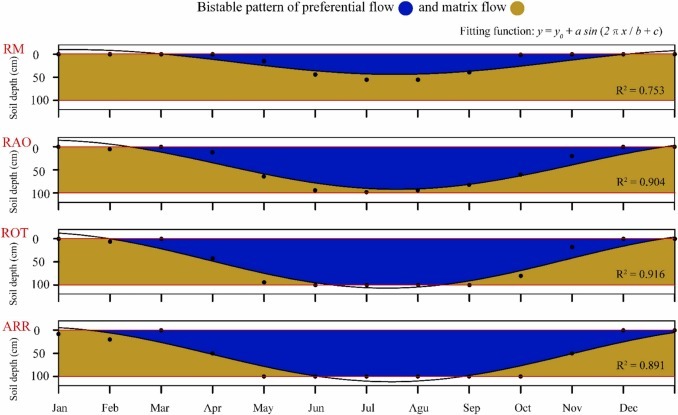
Bistable states of preferential flow and matrix flow among the four forest systems with different root biomass. (Image by JIANG Xiaojin)
Available online: 29 November 2025


