Pseudobulbs: sink for exogenous nitrogen in epiphytic orchids
The researchers investigated the physiological performance, biomass allocation and nitrogen resorption of P. aurita, a world-famous ornamental and important medicinal orchid plant, under three nitrogen levels. Using 15N, they compared the contributions of exogenous nitrogen and stored nitrogen, and the allocation to each organ.
They found that the leaf took up the largest proportion of both fertilizer and old pseudobulb-stored nitrogen. The fruit preferred to use pseudobulb-stored nitrogen regardless of exogenous nitrogen supply. The resorption of nitrogen in the leaf and pseudobulb was more efficient than other plant organs, but decreased with increasing nitrogen availability.
“Our results suggested an important role of the pseudobulb in the nitrogen economy of P. aurita, and the high dependence of the reproduction process on the pseudobulb-stored nitrogen rather than an exogenous supply," said FAN Zexin, a correspondence author of the study.
Key Laboratory of Tropical Forest Ecology, Xishuangbanna Tropical Botanical Garden, Chinese Academy of Sciences, Mengla, Yunnan 666303, China
E-mail: fanzexin@xtbg.org.cn
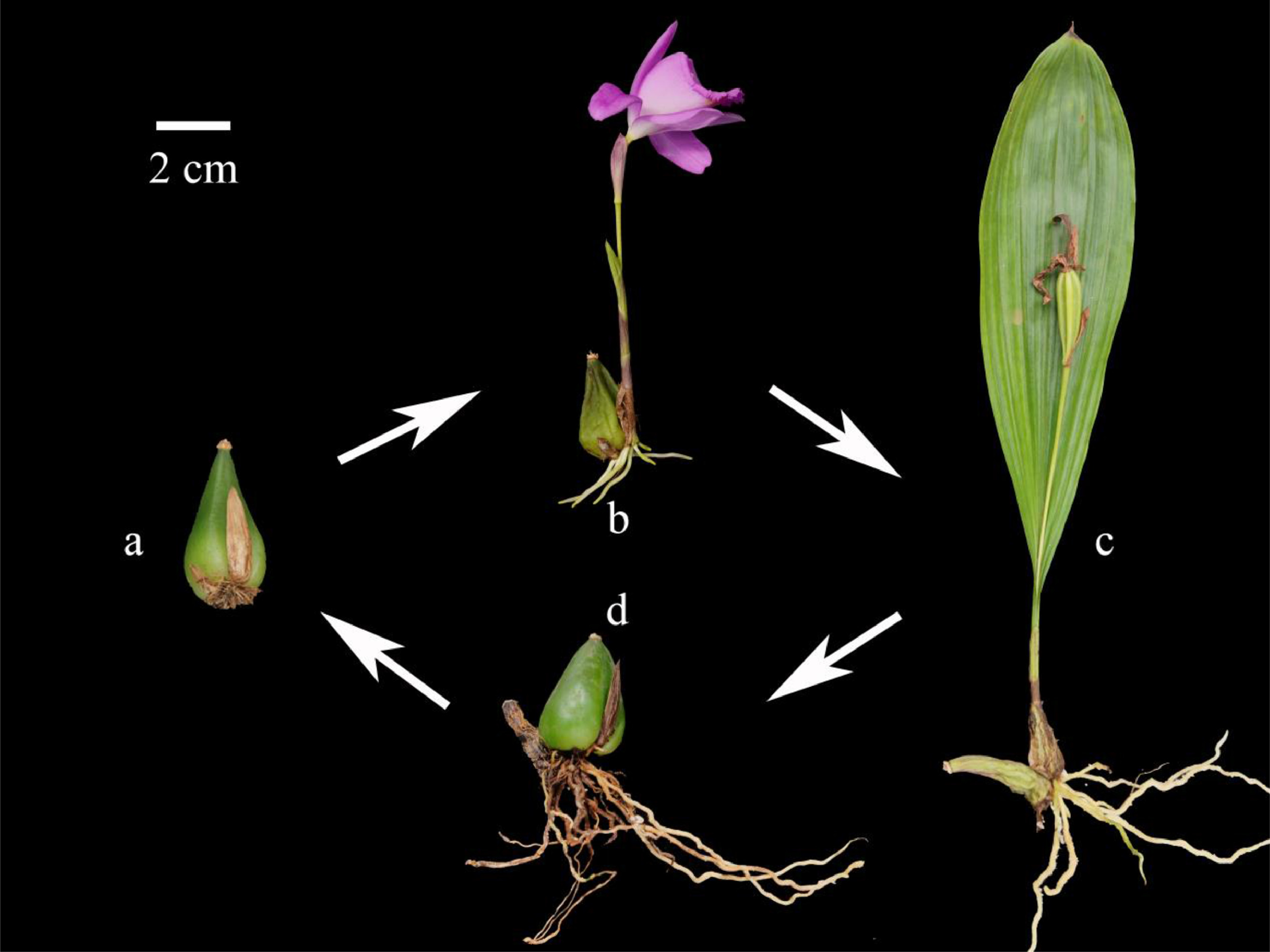
Development of Pleione aurita over a whole growing season. a, Dormant pseudobulb; b, flowering stage; c, full leaf expansion; and d, leaf shedding. (Image by ZHANG Wei)
 Appendix:
 Prev

