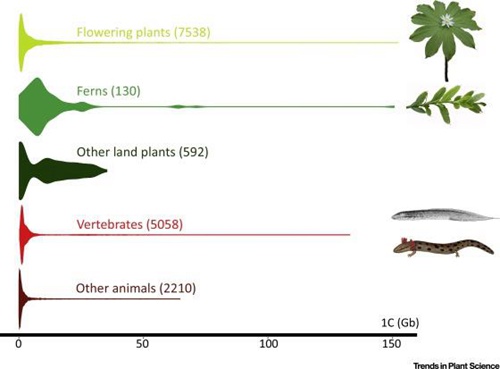
Plant genomes form a universe of dwarfs and giants. In a review study, a team of plant biologist based at the Royal Botanic Garden Kew (UK), the Queen Mary University London (UK), and XTBG (Harald Schneider, Macroevolution & Conservation Group, CIC) addresses the limits of obesity in eukaryotic genomes (Hidalgo et al. 2017 Trends in Plant Sciences http://www.sciencedirect.com/science/article/pii/S1360138517300705).
The study was inspired by the recent discovery that the whisk-fern Tmesipteris obliqua has a genome comparable in size to the record holders in plants, namely the monocot Paris japonica and the lungfish Protopterus aethopicus (see Hidalgo et al. 2017 Botanical Journal of the Linnean Society https://academic.oup.com/botlinnean/article-abstract/183/4/509/3739733/Genomic-gigantism-in-the-whisk-fern-family?redirectedFrom=fulltex t).
The authors argue by considering different aspects of the biology of genomes that the record holders in angiosperms, ferns, and lungfishes have converged to an upper maximum of genome size preventing genomes to exceed 150 GB.
The study also stressed that each case of very large genomes (> 100 GB) involved different mechanisms to approach this maximum value. Interestingly, ferns comprise with Tmesipteris oblique not only one of the largest genomes recorded but with Ophioglossum reticulatum also the record holder in the number of chromosomes per cell nucleus.
 Appendix:
 Prev

