Agreed criteria necessary to decide if and when to intervene in conservation
One global consequence of economic development is that large areas of marginal agricultural land are being abandoned—in upland areas, on steep slopes, and on poor soils—as agriculture becomes concentrated on the most productive land. These abandoned areas are then potentially available for biodiversity conservation and many strategies have been developed. By consulting a large amount of literature, Prof. Richard Corlett of Xishuangbanna Tropical Botanical Garden (XTBG) reviewed the strategies and discussed some of the options that have been suggested and identified the major research gap in modern conservation.
Various strategies have been developed for promoting conservation on abandoned land, including ecological restoration (returning an ecosystem back to the way it was) and reintroduction (returning a species back to where it used to live) of species that have become locally extinct. A third strategy, ‘rewilding’ (returning a managed area back to the wild), tries to restore natural processes and minimize future human interventions.
All three strategies have a target of returning the area to a state more similar to that which existed in the past, before human impact. However, many environmental changes in recent decades and centuries are, in practice, irreversible. Climate change is an obvious example of this, but there have also been irreversible changes in the atmospheric composition, the soil structure and nutrient availability, and the flora and fauna, as a result of extinctions and species introductions. Past ecological conditions can be used as guide but conservation must look forwards, not backwards.
The researcher found that many of the recently proposed interventions have been – and often still are – controversial and there is a danger that policy makers will pick actions from the expanding menu on grounds of cost, convenience, perceived ‘coolness’, or political acceptability, whereas the risks of unforeseen consequences are overlooked. He suggests that the most important conservation debates in the coming decades will probably not be about baselines, targets, and techniques, but about if and when to intervene, and that agreed criteria to facilitate these decisions are necessary.
The researcher also suggested that it may be useful to develop a new vocabulary for the developing forward-looking conservation paradigms, rather than trying to stretch the meanings of terms that are inherently backward looking.
The study was funded by the 1000 Talents Program (WQ20110491035) and has been published with a title “Restoration, Reintroduction, and Rewilding in a Changing World” online in Trends in Ecology & Evolution.
Contact
Richard Corlett Ph.D Principal Investigator
Center for Integrative Conservation, Xishuangbanna Tropical Botanical Garden, Chinese Academy of Sciences, Menglun, Mengla, Yunnan 666303, China
E-mail: corlett@xtbg.org.cn
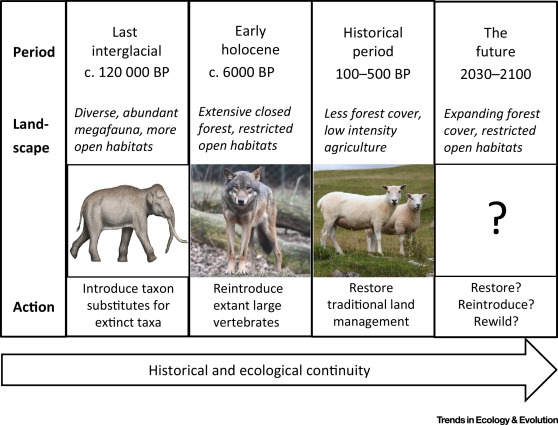
Possible conservation baselines in Europe (Image by Richard Corlett)
 Appendix:
 Prev

