Ficus (Moraceae) is a pantropical genus containing over 750 species that is of great ecological significance because of the large numbers of animals that feed on figs, also known as syconia. In obligate mutualistic systems such as that involving figs and fig wasps, selection generated by one partner elicits morphological and behavioral responses in the other, leading to their co-evolution.
Given the importance of ensuring synchrony of fig wasp attraction with immediate access to receptive figs, the discovery of a fig tree that attracts pollinators before they can enter its figs would be surprising, but this appears to be the case with the Asian species F. altissima. The figs of this species are unusual in that they retain large enveloping bracts until the time they are pollinated. A large F. altissima individual at Xishuangbanna Tropical Botanical Garden (XTBG) was monitored for 10 years.
Prof. YANG Darong and his team of XTBG conducted a study to (1) characterize the relationship between the timing of fig wasp arrivals and the developmental states of F. altissima figs, (2) examine ecological consequences of a mis-match between pollinator attraction and pollinator entry by recording the reproductive success of the figs and pollinators in relation to pollinator and fig age and (3) determine whether premature attraction to trees before their figs can be entered has selected for extended longevity among the agaonids associated with the tree.
In that study, they described an anomalous relationship between F. altissima and its wasps. Since F. altissima growing naturally in the forest are very tall, or if they are planted in a city they are easily influenced by human activity, it is difficult to closely observe the behavior of their tiny fig wasps. Only one tree at XTBG was continuously observed 10 years, with the aid of a viewing platform, but the phenomenon of pollinators being attracted to inaccessible was regularly observed each year. Furthermore, the phenomenon was observed from a distance on other urban and forest fig wasp trees of this species.
Their results opened an interesting and perplexing perspective on the co-evolution of this heavily-studied inter-specific interaction.
The study entitled “Premature Attraction of Pollinators to Inaccessible Figs of Ficus altissima: A Search for Ecological and Evolutionary Consequences” has been published in PLoS ONE.
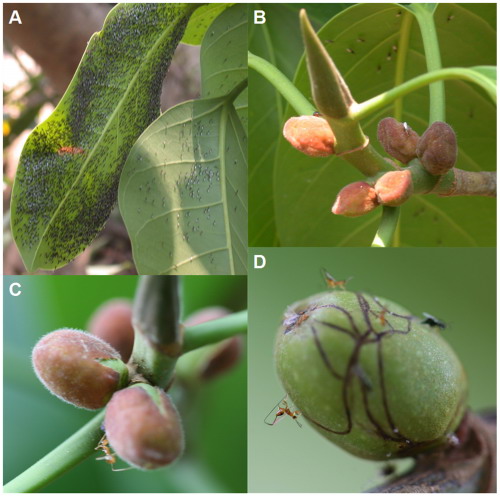
Anomalous phenomenon about early arrival of pollinators and entering the receptive figs. (Image by ZHANG Yuan)
 Appendix:

 Prev
