Weaver ants and pollination
Two new papers explore the relationship between weaver ants (Oecophylla smaragdina) and the pollination of flowers by bees. One of the authors, Francisco Gonzálvez, collected data on interactions between weaver ants and bees at XTBG in 2011 and another, Richard Corlett, is now a professor at XTBG. In the first paper, the authors found that the flowers of Melastoma malabathricum attract weaver ants that deter small bees, which are ineffective pollinators, while having no effect on the larger Xylocopa bees, which are effective pollinators. As a result, Melastoma flowers that were occupied by weaver ants had higher reproductive success than unoccupied plants. For the second paper, the authors made observations on weaver ants visiting the flowers of 48 plant species in 32 families from tropical Australia to Xishuangbanna and recorded their interactions with flower visitors. The ants attacked flower visitors on 31 of the plant species and were seen to capture them successfully on 15 species. Several ants cooperate together in order to capture bees much larger than themselves. This survey suggests that weaver ants may be significantly influencing pollination interactions in numerous plants species across tropical Asia.
The two papers have been published recently in Journal of Ecology:
Gonzálvez, F.G., Santamaria, L., Corlett, R.T., and Rodríguez-Gironés, M.A. (2013) Flowers attract weaver ants that deter less effective pollinators. Journal of Ecology101: 78-85.DOI: 10.1111/1365-2745.12006
Rodríguez-Gironés, M.A., Gonzálvez, F.G., Llandres, A.L., Corlett, R.T., and Santamaria, L. (2013) Possible role of weaver ants, Oecophylla smaragdina, in shaping plant-pollinator interactions in South-East Asia. Journal of Ecology DOI: 10.1111/1365-2745.12100
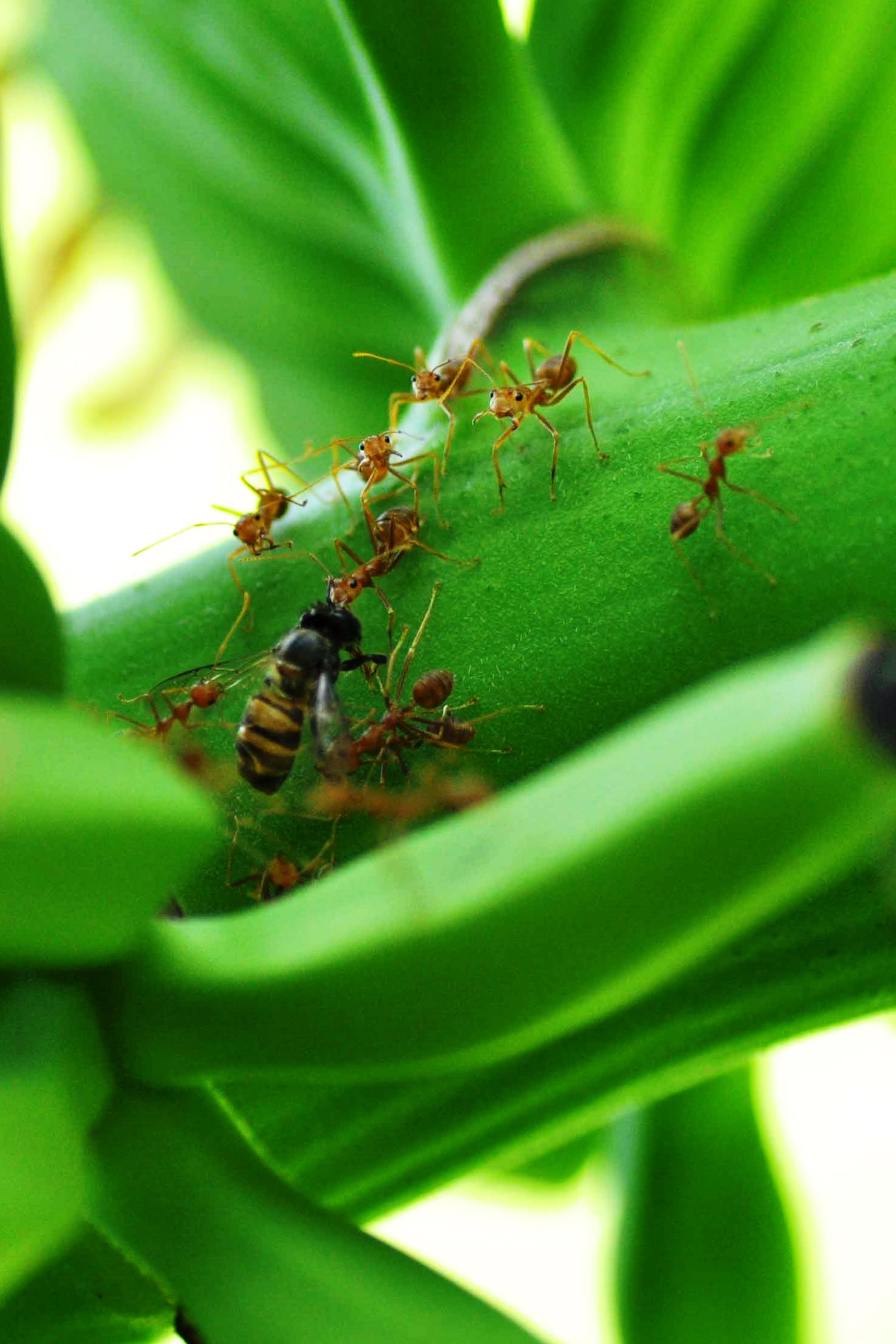
Weaver ants with a captured bee at XTBG. (Photo by Francisco Gonzálvez).
 Appendix:
 Prev

