Richard tells you where the subtropics are
The tropics are clearly defined but the term ‘subtropics’ has been used in numerous different ways. Scientists have proposed dozens of different definitions, but no single definition has achieved widespread acceptance. As a result it has been difficult to make comparisons between ‘subtropical’ sites in different parts of the world and the study of subtropical ecology lags far behind the study of tropical ecology. This is unfortunate because subtropical areas make up a large proportion of many countries, including China, India, Mexico, Argentina, South Africa and Australia. In Asia, there is more land in the subtropics than in the tropics.
Prof. Richard Corlett of Xishuangbanna (XTBG) investigated the use of the terms ‘subtropics’ and ‘subtropical’ in the recent international ecological literature. He found 180 articles from 14 countries, with the majority from China, Argentina, Australia and South Africa. Despite the lack of an agreed definition, most authors used these terms to refer to sites between the edge of the tropics (+/- 23.4o) and 30o north or south. These two broad zones, north and south of the tropics, are characterized by year-round warmth, except for a brief cool winter. In humid areas, the natural vegetation is a distinctive type of evergreen broad-leaved forest that looks similar, and shares some plant genera, in all major subtropical regions.
The study concluded that the restriction of the terms subtropics and subtropical to the zones between the edge of the tropics (+/- 23.4o) and 30o north or south would encourage international comparisons and research collaborations.
The study entitled “Where are the subtropics?” has been published online in Biotropica, doi: 10.1111/btp.12028
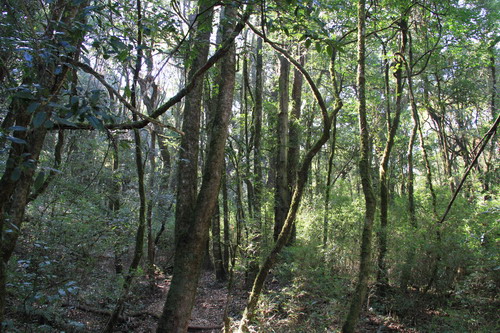
Subtropical forest in Ailao mountain (Image by XTBG)
 Appendix:
 Prev

