Different seed traits affect scatter-hoarding behavior of rodents
To better understand how different seed-traits affect scatter-hoarding behavior, they carefully analyzed the decision making process of a common genus of Old World rodents (i.e. Apodemus) in Shangri-La Alpine Botanical Garden (27°54′N, 99°38′E, altitude 3456 m a.s.l.). Theyhypothesized that 1)the decision making process of scatter-hoarding rodents included four distinct steps; 2) Different seed-traits affect the rodents’ decision making process at each step differently. 3) Each single seed-trait does not have a unified or consistent effect on seed fate at all steps during the foraging process.
Their study found thatthe three different seed-traits (size, nutrient content, and tannin content) indeed affected each of the four steps of scatter-hoarding foraging behavior differently. Seed size significantly affected all steps: the first step (when a seed is encountered, is it manipulated or ignored), the second (eaten seeds in situ or removed them away), third (how far should the seed be removed) and forth steps (eaten or cached the removed seed), while both nutrient and tannin content mainly affected the first and third steps.
Their results indicated that the animals evaluate the cost and benefits associated given different seed-traits at each discrete step. By dissecting foraging behavior in relation to experimentally controlled seed-traits, they have created an effective framework within which to understand the unique relationship between scatter-hoarding rodents that both predate and disperse plant seeds.
The study entitled “Dissecting the decision making process of scatter-hoarding rodents” has been published online in Oikos, DOI: 10.1111/j.1600-0706.2012.20823.x
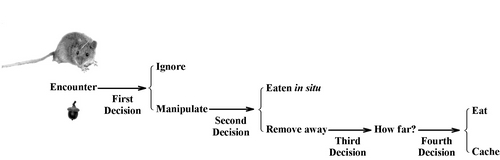
Decision making process of a rodent
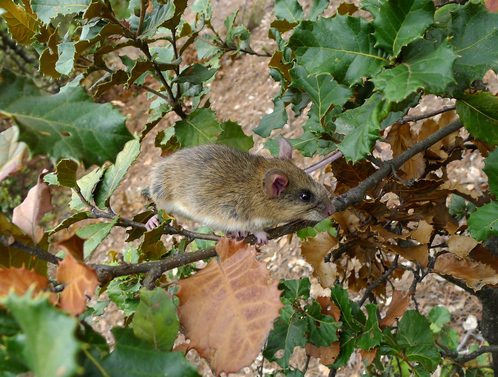
A rodent seeking seeds (Images by Wang Bo)
 Appendix:
 Prev

