Land use changes and conversion of tropical forest influence soil quality
Over the past 30 years, large areas of tropical forest in Xihsuangbanna (21°08′–22°36′N, 99°56′–101°50′E; 19,150 km2) have been converted to a variety of agricultural uses, such as rubber and tea plantations.The expansion of rubber plantation and its impacts on the environment in Xishuangbanna have received much attention by the local government and ecologists. Understanding the effects of land use and topographic position on soil properties can help in guiding sustainable rubber plantation management and recovery of degraded-soil.
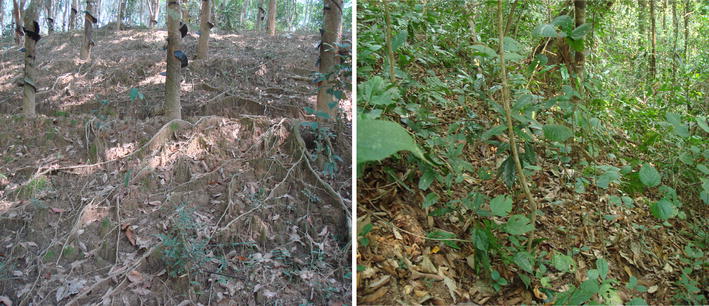
Prof. Ma Youxin and his team of Xishuangbanna Tropical Botanical Garden (XTBG) conducted a study to evaluate the effects of land use and slope on soil properties in seven common disturbed and undisturbed land-types. Their objectives were to clarify whether there is a significant difference in soil properties from different-aged rubber plantations, tea gardens and abandoned cultivated lands compared with tropical forests, and to understand changes in the spatial and temporal dynamics of soil properties in the region.
Their study found that and-use change caused significant changes to soil inorganic N, NH4 +-N and NO3 −-N concentrations, and that conversion of the tropical forest in Xishuangbanna decreased soil organic matter concentration and increased bulk density.
The researchers suggested that rehabilitating tropical forests on the high and steep slope would not only reduce soil erosion but also restore soil nutrient and reduce environmental pollution. On the other hand, keeping a proportional area of forest regeneration on the upper slope as stepping stone fragments was also important for local biodiversity conservation.
The study entitled “Soil Changes Induced by Rubber and Tea Plantation Establishment: Comparison with Tropical Rain Forest Soil in Xishuangbanna, SW China” has been published in Environmental Management, 50 (5): 837-848.DOI: 10.1007/s00267-012-9942-2
 Appendix:
 Prev

